
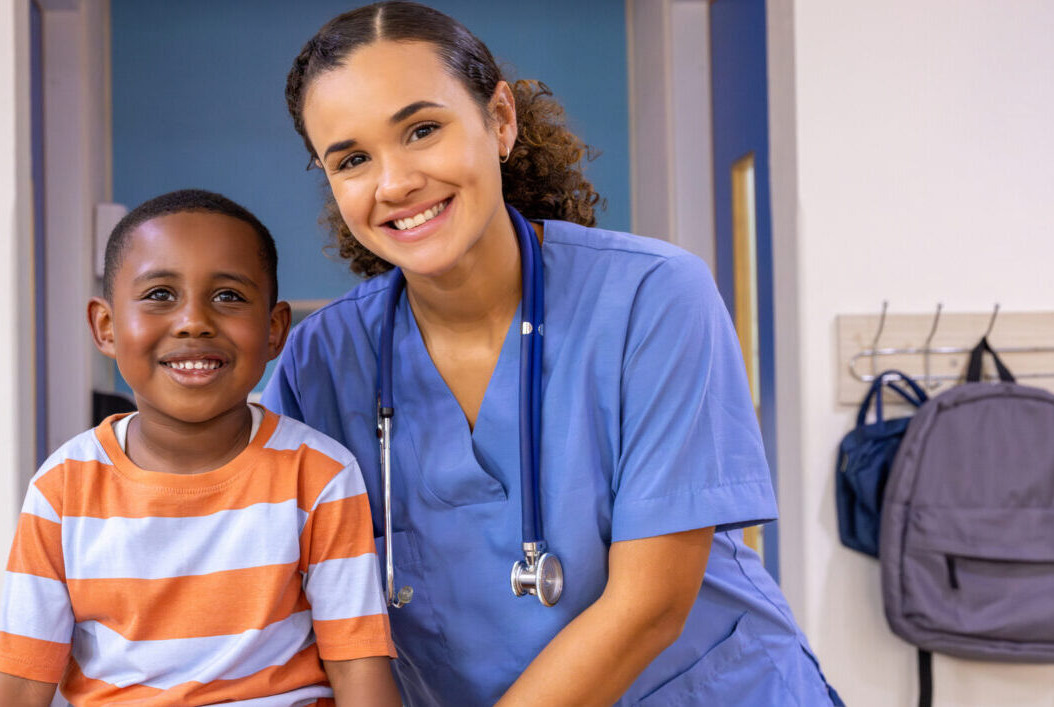
The School Health Program is established by Florida Statutes and is a collaborative effort of the Florida Department of Health and Department of Education.
The school health nursing staff requires expertise in pediatrics, public health, and mental health. Health promotion, assessment, and referral skills are also an integral component of the role.
The school nurse conducts illness and injury assessments and intervention, provides health screenings to students and faculty, handles chronic disease management and education, creates individualized nursing plans for students with special needs or disabilities, helps develop guidelines for school policies, and serves as a liaison between school and community health care needs.
School Immunization Requirements
Any child entering kindergarten in Pinellas County must present proof of the following immunizations:
- 4-5 doses DTaP (Diphtheria-tetanus-pertussis)
- 3 doses Hepatitis B
- 3-5 doses Inactivated Polio (IPV)
- 2 doses MMR (Measles, Mumps and Rubella)
- 2 doses Varicella (chickenpox) or documented evidence of chickenpox disease
Any child entering seventh grade also needs to present proof of a Tdap immunization.
The Florida Department of Health will issue a completed certificate of immunization (DH 680) when the student has received all required immunizations. All immunization dates or exemptions must be on this form.
Please contact your child’s health care provider for immunizations. If your child does not have a health care provider, immunizations are available at no cost at the DOH-Pinellas locations listed below. Appointments are not necessary.
Clearwater
310 N. Myrtle Ave.
Clearwater, FL 33755
Mid-County
8751 Ulmerton Road
Largo, FL 33771
PInellas Park
6350 76th Ave. N.
Pinellas Park, FL 33781
St. Petersburg
205 Dr. Martin Luther King Jr. St. N.
St. Petersburg, FL 33701
Basic School Health Services
Basic school health services, mandated by the School Health Services Act and other Florida Statutes, are provided to all students in Florida public schools and participating non-public schools.
Basic Services
- Health appraisal
- Health records review
- Nutrition assessment
- Referral and follow-up of suspected or confirmed health problems
- Vision, hearing, scoliosis, and growth and development screening (with BMI)
- Follow-up for mandated school entry physical examinations
- Maintenance of student health records
- Health counseling
- Medication administration
- Nurse assessment
- Preventive dental program
- Referral of students to appropriate health treatment
- Follow-up for appropriate grade level immunizations against preventable communicable diseases
- Consultation with student’s parents or guardian regarding health issues
- First aid and emergency health services
- Meeting emergency health needs in each school.
All schools in Pinellas County are provided basic health services. The service is provided by both Pinellas County School (PCS) staff and DOH-Pinellas staff. DOH-Pinellas staff also assists charter schools throughout the county.
Full School Health Services
Full service schools provide the infrastructure necessary to coordinate and deliver services donated by community partners and participating agencies. This program is authorized by Section 402.3026, Florida Statutes, and focuses on underserved students in poor, high risk communities needing access to medical and social services, as identified through local county agency demographics. The full-service schools integrate the services of the Department of Health that are critical to the continuity-of-care process. The department provides services to students on the school grounds. These schools provide all basic school health services, in addition to a range of locally available medical and specialized social services, as an extension of the educational environment.
Services
- Nutritional services
- Aid to dependent children
- Parenting skills
- Counseling for children at high risk for delinquent behavior and their parents
- Medical services
- Counseling for abused children
- Education for the students’ parents or guardians
The effectiveness of this program has been enhanced by the co-location of services for children and their families. Pinellas County School staff provides services to full service schools in Pinellas County through licensed practical nurses that are overseen by registered nurses.
Comprehensive School Health Services
Comprehensive services are intended to provide more in-depth health management through the increased use of school health staff to promote student health, decrease student risk-taking behavior, and reduce the incidence of teenage pregnancy at locally designated comprehensive schools.
The program includes a multidisciplinary team composed of a psychologist, social worker, and nurse whose responsibilities are to provide basic support services and to assist, in the school setting, children who exhibit mild to severely complex health, behavioral, or learning problems affecting their school performance.
Effective preventive services are aimed at delaying:
- Early sexual involvement
- Aimed at pregnancy
- Acquired immune deficiency syndrome
- Sexually transmitted disease
- Destructive lifestyle conditions, such as alcohol and drug abuse
Each team provides student support services to an elementary school, middle school, and high school that are a part of one feeder school system and coordinates all activities with the school administrator and guidance counselor at each school. Current schools receiving comprehensive school health services are Gulfport Elementary School, John Hopkins Middle School, Lakewood High School, Tarpon Springs Elementary School, Tarpon Springs Middle School, and Tarpon Springs High School.
Program services include:
- Planning, implementing, and evaluating school health services. Staffing shall include a full-time, trained school health aide in each elementary, middle, and high school; one full-time nurse to supervise the aides in the elementary and middle schools; and one full-time nurse in each high school.
- Providing student health appraisals and identification of actual or potential health problems by screenings, nursing assessments, and record reviews
- Expanding screening activities
- Improving the student utilization of school health services
- Coordinating health services for students with parents or guardians and other agencies in the community
DOH-Pinellas County staff provides services to comprehensive service schools in Pinellas County through utilizing certified nursing assistants that are overseen by registered nurses. The schools that receive this service are Tarpon Springs Elementary School, Tarpon Springs Middle School, Tarpon Springs High School, Gulfport Elementary School, John Hopkins Middle School, and Lakewood High School.
Examinations and Screenings
Chapter 1003.22, Florida Statutes, requires any child who is entering a Florida school for the first time to present proof of a physical examination. This exam must include a review of all body systems and be performed by a licensed medical provider within 12 months prior to enrollment. A yearly physical examination and twice yearly dental visits are recommended for all children. Screenings your child will get at school:
- Vision: Kindergarten and first, third, and sixth grades
- Hearing: Kindergarten and first and sixth grades
- Height, weight, and body mass index (BMI): First, third, and sixth grades
- Scoliosis: Sixth grade
Additional Screening Information
Parents may request in writing any screening at any grade level.
Any parent who desires to opt their child out of a screening must do so in writing up to the day of the screening. The opt out request must contain the student’s name, grade and the screening(s) you do not want performed.
If your child’s vision, BMI, hearing, or scoliosis screening results are outside normal limits, you will receive a letter with information and/or follow-up instructions/resources. The screening and follow-up results will be noted in your child’s health records.
Type 1 Diabetes
Type 1 diabetes is a lifelong autoimmune condition causing the destruction of the cells in the pancreas that make insulin. This means the body can’t control blood sugar (glucose) on its own. Without management of high blood glucose levels, over time it can lead to serious and life-threatening health complications.
Type 1 diabetes often starts in children ages 4-6 and 10-14, but it can happen at any age. Studies indicate that screening for autoantibodies through a simple low to no-cost blood test can effectively identify those who will develop type 1 diabetes, potentially before the need for insulin. It can also identify the stage of the condition.
Although our school health services program does not offer screenings in schools, there are free resources available:
- TrialNet.org offers free at locations and free home test kits for relatives of people with Type 1 diabetes.
- AskHealth.org provides free at home screening test kits to children and adults.
You can also talk to your child’s health care provider about screening options.
Medications at School
When possible, give medications at home. School personnel will administer approved medications to students during the school day when it is necessary to help them stay in school. In order to administer medications or treatments to your child at the school the following conditions must be met:
- A medication/treatment authorization form must be on file at school for any medications to be administered in school (including over the counter medications).
- Medication must be in the original prescription or unopened over-the-counter container labeled with the child’s name, medication name, dosage, and specific time(s) to be administered.
- Parent/guardian must deliver the signed medication/treatment authorization form and medication directly to the school so that medications can be accepted and counted.
If you have questions or concerns about how your child’s health needs are being managed, contact your school.